BOOKS BY STEVE J. WAGNER
A catalog of books and major works by Steve J. Wagner, including the Deconstruction Works, the Major Arcana Tarot series, Celestial Currents, and independent publications.
The work moves through spirituality, consciousness, Tarot, metaphysical fiction, non-linear time, identity, authority, collapse, and deconstruction. Some titles are available in paperback and Kindle through Amazon. Others are published as full web essays, dedicated reading hubs, or free downloads within the Deconstruction Library.
For the connected reading path, expanded work pages, and access to every available edition, visit the Deconstruction Library.
DECONSTRUCTION WORKS
The Deconstruction Works trace what happens when inherited spiritual stories, metaphysical assumptions, authority systems, and identity structures are examined without the requirement that they remain comforting.
These works move from the collapse of false ascent and linear-time narratives to a deeper examination of the human experiment, institutional authority, fragmentation, and the practical demand for coherence after old frameworks fail.
The Deconstruction Works form a connected sequence from Simpatico through The Empty Mirror. Explore the Deconstruction Library →
SIMPATICO: Reconciling the Disparity of Spirituality, Ancient Wisdom,
and Modern Science
The book that began the inquiry. SIMPATICO brings spirituality, ancient wisdom, sacred symbolism, lived experience, and modern scientific language into conversation. It explores correspondences among traditions and disciplines often treated as incompatible, opening a search for meaning across spiritual practice, sacred teachings, symbolic systems, personal experience, and scientific thought.
This foundational work opens questions of meaning, authority, identity, consciousness, and participation—questions that later works in the Deconstruction Library revisit, test, complicate, and, where necessary, dismantle.
An Essential Supplement to SIMPATICO
A companion volume expanding selected teachings, source material, and practical context from SIMPATICO. The Supplement develops early frameworks involving the Shamanic Cosmic Web Model of Time, the 72 Sacred Names, and the Divine Hierarchy. It travels alongside SIMPATICO as an added reference resource; it does not replace or interrupt the primary reading sequence.
The Illusion of Linear Time: The Root of Modern Spiritual Fallacies
What happens when the past–present–future story is no longer treated as an unquestioned fact? The Illusion of Linear Time examines the hidden linear assumptions beneath reincarnation, karmic debt, soul contracts, twin flames, manifestation, destiny, spiritual evolution, and future ascension. It argues that these systems often depend on a sequence of “before” and “after” that may be more interpretive scaffolding than the architecture of reality.
Drawing together non-local consciousness, the Shamanic Cosmic Web, Over Soul and fractal identity, resonance, and a simultaneous field of experience, this work does not offer another spiritual doctrine. It asks readers to test the stories they inherited against the consequences of a world in which time does not simply move forward. When the old explanations no longer hold, the question becomes immediate: how do you live, choose, take responsibility, and meet the life already in front of you?
The work argues that these familiar stories are not automatically sacred because they are comforting. When the foundation is false, the narratives built upon it cannot stand.
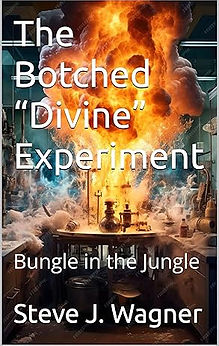
The Botched “Divine” Experiment: Bungle in the Jungle
The Botched “Divine” Experiment takes the inquiry to the most protected premise of all: that the human condition must be the expression of a perfect Creator, perfect plan, and perfect purpose.
If a system requires suffering, fear, fragmentation, biological expendability, spiritual escape narratives, and institutional control simply to make existence bearable, then calling it “divine” does not place it beyond examination. It places it under review.
This book investigates the alleged human experiment; the roles assigned to Lucifer/Samael, the Gnostic Demiurge, and the ego; the religious narratives used to rationalize suffering and authority; and the Church’s use of Hell, Purgatory, Satan, and spiritual debt as instruments of fear and compliance.
It also turns toward the recovery questions the original architecture appears not to have answered: fragmentation, failed return, reintegration, extraction, and the practical work of restoring coherence. This is not an attack on faith. It is a refusal to call a system flawless merely because its designer was declared perfect.
Read the Deconstruction Works
The Deconstruction Library is the central reading map for this connected body of work.
Some works are available in Kindle and paperback editions. Others are published as full essays on this site, a linked trilogy, or a free downloadable capstone. The Library provides the intended reading path, expanded work summaries, and the direct route to each dedicated page, live essay, Amazon edition, or reader download.
The Dark Side of Ascension: Not Rapture, But Rupture
Ascension is often sold as elevation: a reward for healing enough, learning enough, raising one’s vibration, and becoming spiritually advanced. This work challenges that promise directly.
The Dark Side of Ascension examines ascension as rupture rather than rapture—the collapse of the beliefs, identities, coping strategies, roles, and inherited frameworks that once made life intelligible. It confronts the moment when the familiar story cannot survive lived reality, and the person is left in the crater of what has fallen away.
This is not a polished tale of instant enlightenment. It is about the disorienting threshold where false structures burn, the old self no longer holds, and clarity begins only after collapse.
Modern Spirituality Will Never Bring Awakening or Ascension
Modern spirituality promises awakening while often preserving the very dependency, avoidance, false authority, and emotional performance that prevent it.
This post-collapse analysis examines the spiritual marketplace of slogans, “high-vibe” reassurance, karmic explanations, promised destiny, and endless self-improvement. It asks what happens when those narratives no longer explain suffering, fragmentation, or the failure of the systems that claim to guide people through them.
Rather than presenting awakening as a glowing upgrade, this work frames it as exposure: the collapse of false roles, inherited programming, and spiritual consolation. What remains is not a packaged answer or a new doctrine, but the demanding work of authenticity, coherence, discernment, and accountability in the aftermath.
The Three Traps of Modern Seeking: The Path to Nowhere
A three-part examination of the loop that keeps people seeking while never reaching genuine transformation: safe space without discernment, false authority and spiritual theatrics, and an economy that benefits when people remain wounded, dependent, and perpetually in process.
The Three Traps of Modern Seeking examines the self-reinforcing cycle that keeps people seeking transformation while never reaching the conditions that make genuine change possible.
The sequence begins with “safe spaces” that protect comfort at the expense of discernment. It moves into spiritual performance, false authority, and the rise of personalities whose identity depends on being seen as enlightened, wounded, exceptional, or indispensable. It concludes with the trauma economy: the system of endless processing, branding, dependency, and monetization that benefits when people remain permanently broken and perpetually in search of repair.
The trilogy is not an attack on care, community, healing, or support. It is a challenge to any environment that turns vulnerability into identity, substitutes affirmation for truth, and makes liberation less profitable than keeping people in the loop.
Part One: How “Safe Spaces” Actually Keep You From “Finding Yourself”: The Cycle of Seeking but Staying Lost AF.
What begins as refuge can become another enclosure when safety is confused with immunity from challenge, friction, discernment, or direct self-examination.
This installment examines how a seeker can remain protected, validated, and continuously “in process” while never confronting the roles, beliefs, relationships, and patterns that keep them lost. It asks whether a space that cannot tolerate truth, disagreement, or accountability can actually support the work of finding oneself.
Part Two: The Rise of the Spiritual Narcissist: From Safe Space to Theatrical Performance
When discernment is abandoned, performance rushes in to fill the vacuum.
This installment examines the false teacher, spiritual narcissist, and charlatan whose authority depends on being watched, believed, admired, needed, or feared. Their claimed gifts, wounds, visions, spiritual rank, healing power, special access, or enlightened status may be real, exaggerated, borrowed, invented, or wholly fabricated. The claim is not the proof. The structure built around it is what must be examined.
The false teacher operates through the Facade Network: fakery, deception, illusion, spiritual gloss, mystique, curated vulnerability, borrowed wisdom, inflated roles, theatrical language, public wounds, and the repeated misleading performance of being uniquely awakened, chosen, gifted, traumatized, or indispensable.
This is how the con works. The performance creates an atmosphere in which ordinary uncertainty becomes proof of special access, emotional display becomes proof of depth, vague language becomes evidence of wisdom, and a carefully maintained persona becomes spiritual authority. The audience is not being led toward discernment. It is being recruited to maintain the performer’s identity, status, attention, control, financial support, and ego supply.
The seeker is assigned a role in the system: admirer, follower, customer, dependent, rescuer, witness, or believer. What is sold as guidance becomes a relationship organized around hierarchy, performance-based belonging, and the protection of the teacher’s ego. The result is not clarity or liberation, but dependence on a person whose authority must be continually fed and defended.
The question is not whether the persona is convincing. The question is whether the structure can survive truth: accountability, contradiction, scrutiny, boundaries, the refusal to flatter, and the loss of an audience. Where authority requires constant recognition, where vulnerability becomes branding, and where seekers are used to feed an inflated identity, the work has ceased to be about truth.
Part Three: The Trauma Economy—Monetization of the Broken
The Trauma Economy is the market built around the wounded seeker. It is the condition that makes the other traps profitable: people who are hurting, fragmented, disoriented, lonely, frightened, searching for explanation, or desperate for relief become an available audience for false teachers, opportunists, spiritual performers, and institutions that know how to turn need into recurring attention, dependence, and revenue.
This installment examines the systems, services, personalities, and institutions that exploit an existing market of wounded and lost people—people who are fragmented, disoriented, lonely, frightened, searching for explanation, or desperate for relief, direction, belonging, and a way back to themselves. It looks at the ways pain and disorientation are converted into branding, vulnerability into content, unresolved trauma into identity, and the search for relief into an endless customer relationship.
Opportunists recognize that this market is already looking for a guide. They borrow the language people want to hear—“safe space,” “finding yourself,” “authentic self,” “healing,” “alignment,” “community,” “integration,” “trauma-informed,” and “spiritual growth”—then position themselves as the person uniquely able to lead the way. They fill the void not because they are qualified, accountable, or capable of doing the work they promise, but because being needed gives them recognition, status, appeal, influence, and money.
The problem is not care, therapy, support, community, or the reality of trauma. The problem is the structure that benefits when people remain dependent, fragmented, confused, lost, or perpetually “in process.” When healing becomes a brand and brokenness becomes a market, resolution can quietly become less valuable than retention.
The Trauma Economy supplies the audience that the false teacher and spiritual narcissist require. It gives the performer a stream of seekers who can be recruited into admiration, dependence, repeated purchases, and performance-based belonging. It turns the seeker’s legitimate need for help into a resource to be mined by people and systems that require an ongoing supply of wounded and lost customers.
The questions are direct: Who profits from the wound? Who profits from confusion and being lost? Who benefits when a person never leaves the loop? What happens when pain becomes social currency, when progress is endlessly promised but never reached, and when dependency is sold as devotion, community, or spiritual growth?
The Empty Mirror is the reconstruction-oriented conclusion of the Deconstruction sequence: the point after old identities, affiliations, false reflections, and inherited scaffolding no longer provide an identity to perform.
It begins with the difficult question that remains after deconstruction: if the roles, dogmas, narratives, and affiliations that defined you no longer hold, what is left? The answer is not a pristine hidden self waiting to be discovered, another belief system to adopt, or a sentimental promise that the wreckage will resolve itself.
This work is written for the senior seeker—the person who has crossed many thresholds, outlived too many teachings, communities, promises, and restarts, and earned the discernment that only experience can provide.
It is for those no longer waiting for another sign, revelation, teacher, spiritual identity, or promised higher state to tell them what comes next. The work turns attention back to the life in front of them: the person, ego, and physical body that must engage this world, take responsibility for choice and consequence, and begin building a life that can hold.
What remains is authentic ground: the capacity to perceive, choose, respond, test reality, establish boundaries, build deliberately, and reconnect with life without returning to the structures that failed. The work turns from collapse toward reconstruction—not as a return to old dogma, but as the conscious construction of identity, tribe, daily structure, relationship, and responsibility in the world as it is.
Other Books
Beyond the foundational work and the Deconstruction sequence, Steve J. Wagner’s catalog includes Tarot and metaphysical fiction.
The Major Arcana: The Essential Tarot Series
Tarot without the whitewashed New Age bullshit.
Ancient mysteries get a modern remix and collide headlong with contemporary insanity. The Major Arcana brings the Tarot’s twenty-two central archetypes into direct contact with modern life—its pressure, confusion, humor, desire, collapse, consequence, and possibility.
This is not a polite or sanitized Tarot guide. Written in the unfiltered, irreverent spirit of a real face-to-face conversation, it uses sarcasm, dark humor, and clear-eyed observation to strip away spiritual performance and mystical evasions. The cards are not presented as fixed predictions, cosmic instructions, or substitutes for discernment and responsibility; they are archetypal lenses for recognizing what is actually happening in a person’s life.
From the Fool’s plunge into the unknown to the Tower’s collapse and the Lovers’ collision of desire and consequence, this opening volume of The Essential Tarot Series treats the Major Arcana as a journey through the choices, thresholds, and realities that shape a human life. It is Tarot for readers who can tolerate an honest answer, a sharp laugh, and a closer look at the life they are actually living.
Celestial Currents: The Unscripted Soul
A metaphysical coming-of-age novel about identity, embodiment, choice, and the life that refuses to follow a clean cosmic script.
Celestial Currents follows Alice, a queer seeker whose life begins with a vision of spiritual purpose but unfolds through the far messier realities of incarnation: conditioning, love, loss, illness, relationship, calling, and the choices that cannot be made for her.
As Alice moves from spiritual expectation toward a more grounded way of living, the novel asks what remains when a person can no longer rely on a perfect destiny, a cosmic script, or spiritual identity to explain life. Her journey becomes one of learning to meet the body, the world, and the consequences of choice as they are.
Written with warmth, humor, and an irreverent willingness to question easy answers, Celestial Currents is a story of becoming human—not by escaping uncertainty, but by living through it.
Editorial Note: Celestial Currents is not part of the Deconstruction Works sequence, but it travels along a related fault line. Through fiction, it asks what remains when spiritual expectation, identity, and the fantasy of a perfectly scripted destiny can no longer carry the weight of a real life. Alice must meet the body, relationship, loss, choice, and responsibility as they are—and build from there.
Independent Publications
Steve J. Wagner’s writing also appears beyond this website.
Practical Ways to Be More Spiritual
Originally selected and published by TUT — The Universe Talks, this was Steve J. Wagner’s first published work. It begins with a deceptively simple proposition: becoming “more spiritual” does not require becoming less human.
Rather than treating spirituality as a specialized performance, a distant state of elevation, or an escape from ordinary life, the article locates it in attention, intention, participation, and presence. Exercise, time in nature, creative work, cooking, shared food, family gathering, honest conversation, and service to one’s tribe become places where a person can fully show up.
That grounding impulse is an early expression of a theme developed more rigorously throughout the later Deconstruction Works. The movement that begins with practical engagement in one’s actual life ultimately returns, after the collapse of false spiritual scaffolding, to The Empty Mirror: a life built through discernment, embodiment, relationship, responsibility, and deliberate participation in the world as it is.