
Understanding the Trauma Economy: A Guide for Seekers

Updated: Sep 19
The Wound and the Search for Healing
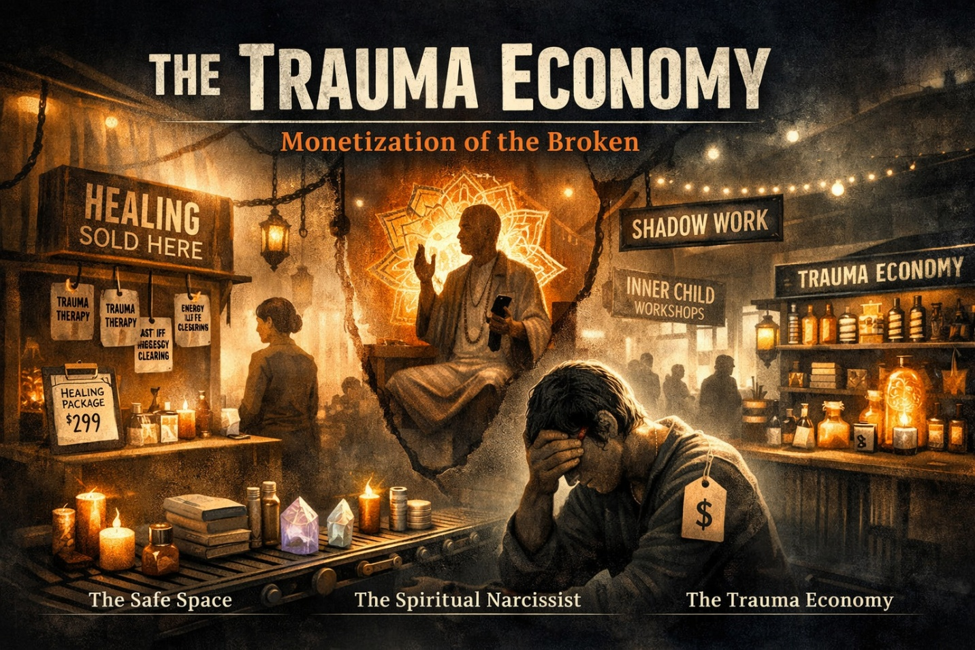
The seeker does not enter the spiritual landscape as a blank slate. They arrive carrying the original wound. This wound may stem from religious, familial, or existential trauma. It fractured their sense of safety long before they ever stepped into a healing circle. They also carry the institutional and social programming that shaped them. This indoctrination taught them who they were allowed to be. It enforced narratives about what “finding the self” should look like. The wound is not just pain; it is the betrayal of the seeker’s core identity by the very institutions and family structures that claimed to protect it.
The wound creates a vacuum. The vacuum creates longing. Longing drives the search for a place where old triggers cannot reach. This is how the Safe Space is born.
The Nature of Safe Spaces
However, the Safe Space is not neutral. It dulls discernment. It replaces structure with sentiment. It rewards openness before trust is earned. It encourages vulnerability without verifying who is listening. The seeker believes they’ve found sanctuary, but the environment quietly shapes them into someone easier to influence.
Their search for healing becomes an opportunity for someone else to recruit a paying client, a follower, or a believer. This is the first turn in the trauma economy: the wound becomes the entry point, and the longing becomes the leverage.
Verification vs. Vibe
Verification over vibe is the dividing line the seeker was never taught to draw. Vibe feels warm, intuitive, and familiar. Verification is cold, demanding, and inconvenient. Vibe promises connection. Verification demands objective evidence of a teacher’s character and the tangible results of their methods. Vibe is the decorated cage. Verification is the key that opens it.
Without that distinction, the seeker cannot tell the difference between insight and imitation, between a guide and a grifter.
The Beginning of the Trauma Economy
This is where the trauma economy begins. The seeker’s unresolved wound becomes the commodity. Their pain becomes the product. Their longing becomes the resource others extract from. Healing is replaced with perpetual becoming. Deconstruction becomes a lifestyle. The wound becomes a persona. Healing becomes an identity that must be performed to remain part of the group.
In this landscape, trauma becomes currency. Pain becomes content. Emotional disclosure becomes social capital. The community rewards the wound, not the repair. The unresolved state becomes the business model.
The Industry of Deconstruction
This is the industry of deconstruction. It thrives on exhaustion, confusion, and the belief that clarity is always one breakthrough away. The system does not need collapse — only incompletion.
And this is where the deeper betrayal occurs. The Safe Space cannot lead to ascension. True ascension requires dismantling the myths, fallacies, and inherited narratives that shaped the seeker’s identity. It requires burning down the scaffolding, not decorating it. The Safe Space avoids this work. It preserves the myths. It protects the illusions. It reinforces the programming the seeker came to escape, the habit of external dependency and lack of critical thinking.
The narcissistic grifter avoids ascension for a different reason: clarity ends their influence. Truth dissolves their authority. A seeker who understands the architecture of their own wound cannot be manipulated. Ascension is the one thing the grifter cannot teach, cannot imitate, and cannot survive.
The Loop of Trauma
So, the seeker is kept in a loop — not because they lack capacity, but because the environments they trust are designed to keep them circling the same injury.
The healer economy grows from this soil. Expertise is unregulated. Anyone can claim mastery. Borrowed language becomes authority. Therapeutic terms are used without understanding. Somatic practices become theater. Shadow work becomes spectacle. The wound is displayed, not treated.
This is the loop: Trauma → Safe Space → Clouded discernment → Grifter → Collapse → Return to the wound.
The narcissist is not the cause; they are the symptom. They rise because the environment rewards theatrics over competence, vibe over verification, and performance over protocol. They rise because the wound has never been cauterized.
Reclaiming Discernment
The exit path begins with reclaiming discernment. Reclaiming discernment begins with a shift in priorities:
Evaluation over absorption — thinking instead of inheriting.
Reconstruction over excavation — rebuilding instead of endlessly digging.
Repair over performance — healing instead of performing the wound for attention, belonging, or validation.
Self over spectacle — sovereignty instead of spiritual theater.
A healed seeker is unprofitable. The trauma economy collapses when the wound closes.
Final Conclusion
Healing has an end point. It is not an endless pilgrimage through pain. It is not a lifetime sentence of excavation. It is movement, not maintenance. It is meant to conclude, not consume.
A wound that is closed cannot be monetized. A self that is rebuilt cannot be recruited. A mind that is clear cannot be manipulated. Clarity sees through performance, glitter, and gloss.
The seeker was never broken beyond repair; they were only taught to stay in pieces. The moment they reclaim verification over vibe, the moment they choose reconstruction over endless excavation, the moment they stop performing their pain for an audience that profits from it, the entire structure falls apart.
The trauma economy cannot survive a healed person. And that is the point. Healing is not the end of the journey; it is the exit from the system that was never designed to set them free.
The right teacher leads the seeker to that exit, not to themselves. They do not cultivate dependence. They do not build a following. They teach the seeker to outgrow them. They teach that healing comes from within, not from euphemisms, borrowed language, or buzz phrases. They teach the one truth the trauma economy cannot survive: healer, heal thyself.
This is the moment the seeker turns away from counterfeit teachers, from identity-based groups, and from the vainglorious performances that once passed for wisdom. This is the moment they see both the physical and spiritual worlds as they truly are — without the myths, the fallacies, the veneer, or the inherited beliefs that once shaped their identity. This is the moment they stand alone, not in isolation, but in sovereignty.
Because the truth is simple: the seeker was never meant to live inside the wound. They were meant to outgrow the system that profits from keeping it open.


Comments